

 EN
EN English
 Español
 عربى
عربى русский
 中文简体
中文简体
Kaixin, a high-tech enterprise specialized in the R&D, production and sales of polymer pipeline valves.
Industrial Piping / Materials / CPVC
CPVC Union Ball Valve: How to Spec, Size, and Install It Correctly
Union body patterns, pressure-temperature derating, and the installation habits that keep corrosive chemical lines leak-free.
The transfer skid on line 7 had gone through two stainless steel ball valves in eleven months. Each failure looked the same: chloride stress-corrosion cracking starting at the stem seal and working through the body wall. When the maintenance supervisor finally asked for a thermoplastic alternative, the CPVC union ball valve that went in next has now sat untouched for three years — same acid concentration, same temperature swings, same shut-off duty.
That one paragraph is the practical case for this valve. If you are moving hydrochloric acid, ferric chloride, caustic solutions, or salt-laden process water in the DN15 to DN100 range, a CPVC union ball valve is usually the most direct specification — provided you match the body pattern, end connections, and pressure-temperature rating to the actual service. The sections that follow cover what to verify and where installers commonly undo the valve's advantages.
Anatomy of a CPVC Union Ball Valve
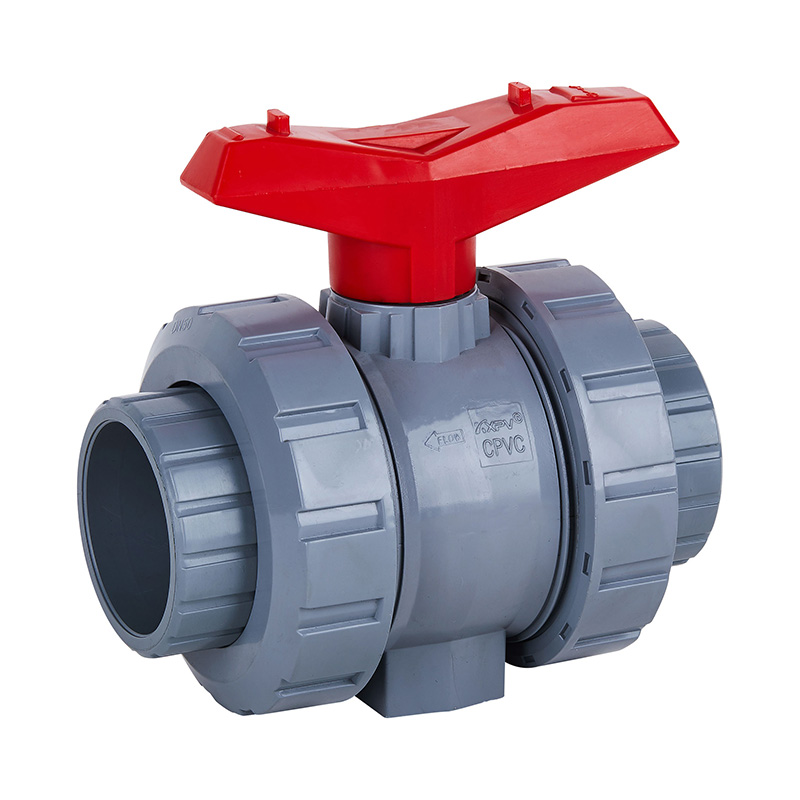
A CPVC ball valve is a simple machine: a molded chlorinated PVC body, a hollow ball with a full bore, resilient seats, a stem, and a handle. What makes it a union valve is the body architecture — one or both ends are separate components that thread or bolt together, so the valve can be opened, inspected, and lifted out of a rigidly installed pipeline without cutting the pipe.
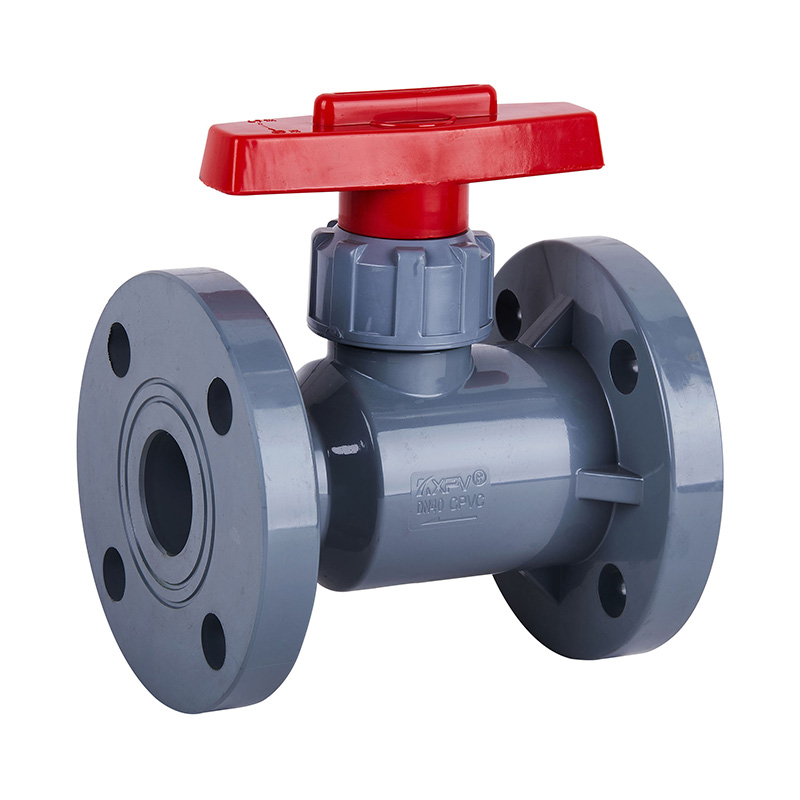
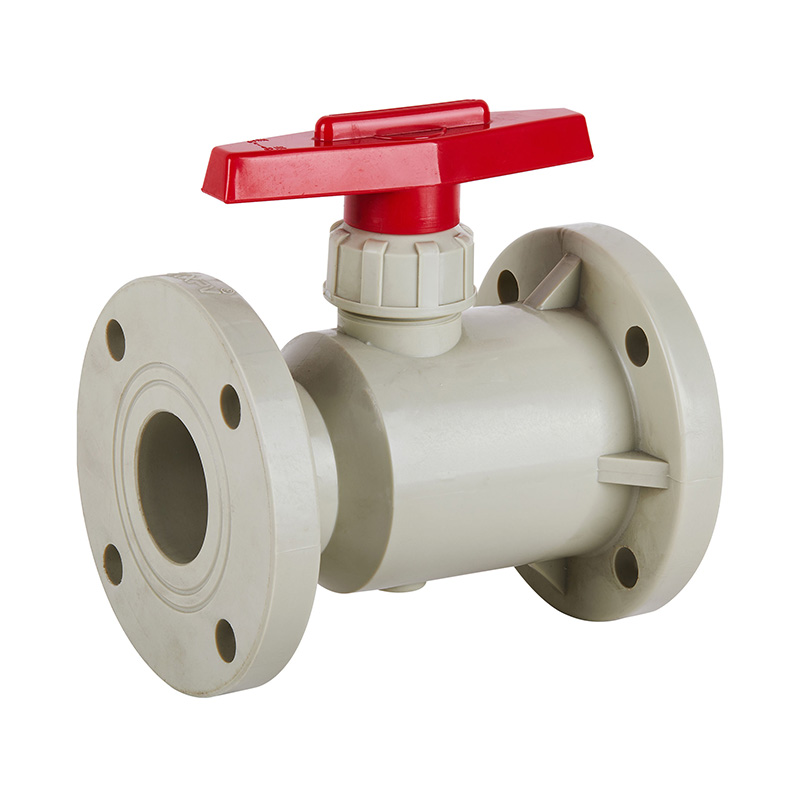
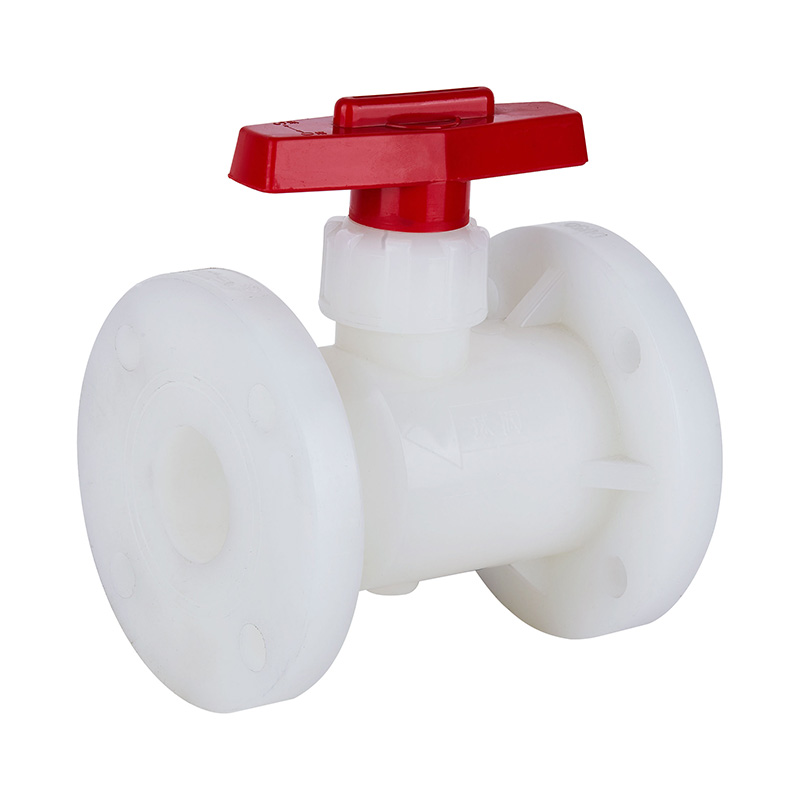
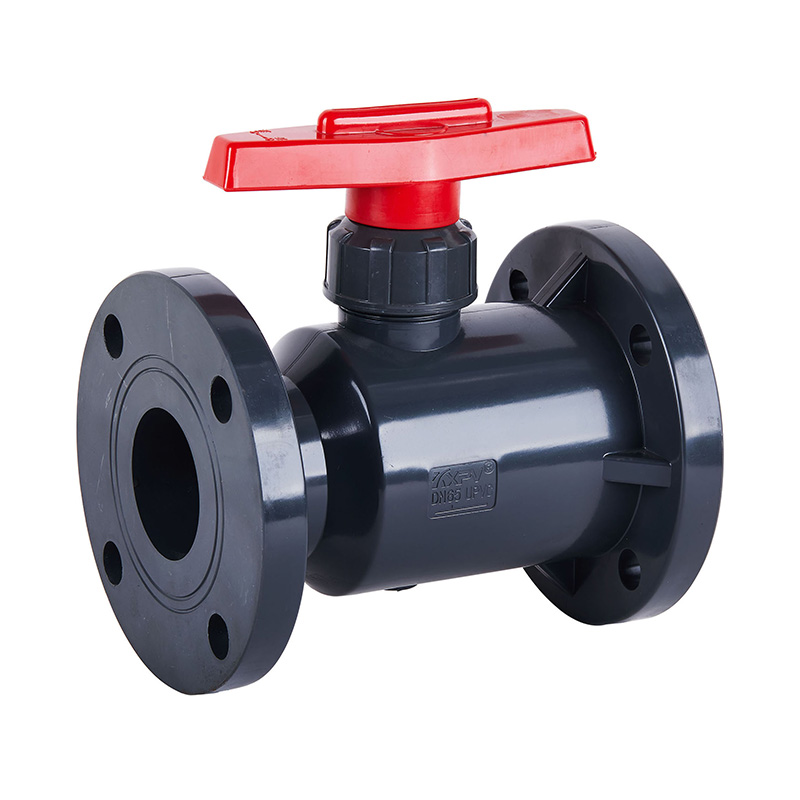
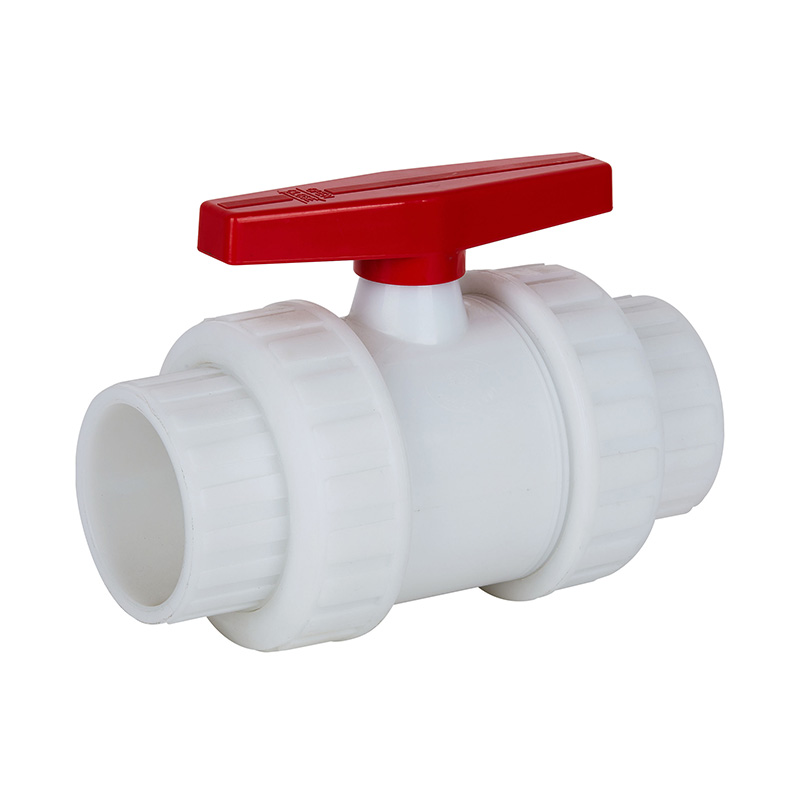
Three patterns dominate the catalogs. A single-union valve has one removable end; it suits lines where one side is fixed and the other can move. A double-union valve has both ends removable, so the entire body can be taken out for seat or stem repair. When flanged connections are required, the double-union design is usually combined with flanges, producing a valve that drops out of a flanged spool without disturbing either side of the plant piping.
For the people who maintain a chemical dosing system, that access is not a convenience; it is the difference between a ten-minute seat replacement and a full line shutdown.
Why CPVC Earns Its Place in Chemical Lines
CPVC — chlorinated polyvinyl chloride — starts as PVC resin and is further chlorinated, which lifts the polymer's usable temperature ceiling. Where unplasticised PVC is usually limited to about 60 °C continuous, CPVC allows service in the 80–93 °C range depending on grade and pressure. That difference makes it one of the most economical thermoplastic choices for hot acid lines, electroplating baths, and chemical feed systems.
Its chemical resistance is broad but not universal. CPVC stands up well to mineral acids, alkalis, saline solutions, and many industrial chemicals; that is why it appears throughout chemical plants, wastewater treatment, and metal finishing. When you are comparing polymers for a specific corrosive stream, the longer material-selection logic for corrosive and abrasive service is worth reading before you commit.
What to expect: a correctly matched CPVC valve in a compatible service typically outlasts the pipe around it. In practice, failures in such systems are joint-related or installation-related, not body failures.
Three Specification Points Most Buyers Miss
Three details determine whether a CPVC union ball valve is a reliable purchase or a recurring maintenance item.
1. End-connection geometry
Socket ends take solvent-cemented pipe; threaded ends suit small sizes and simple service; flanged ends are for larger bores and frequent dismantling. The same model is often offered in all three, and the choice changes installation labor and future access. Read the catalog line carefully: a "double-union valve, flanged ends, DN15–DN100" is not the same as a "socket-end valve with union nut."
2. The pressure-temperature envelope
Manufacturers quote a nominal pressure class — usually PN10 or PN16 — measured at 20 °C. Because CPVC loses strength as temperature climbs, the allowable working pressure falls along a derating curve; a valve quoted at PN16 at 20 °C may be restricted to roughly a third of that value at 90 °C. Compare the envelope with your operating temperature before ordering.
| Body pattern | Maintenance access | Typical end connections | Usual size range |
|---|---|---|---|
| One-piece | None; the valve is cut out of the line | Socket, threaded | DN15–DN50 |
| Single-union | One side removable | Socket, threaded | DN15–DN65 |
| Double-union | Full body removal | Socket, threaded, flanged | DN15–DN100 |
| Flanged double-union | Full body removal | Flanged | DN15–DN100 |
| Fluid temperature | Typical allowable working pressure |
|---|---|
| 20 °C | 16 bar (232 psi) |
| 40 °C | 12.5 bar (181 psi) |
| 60 °C | 9.4 bar (136 psi) |
| 80 °C | 6.6 bar (96 psi) |
| 90 °C | 5.0 bar (73 psi) |
Procurement check: if a datasheet lists one maximum pressure and one maximum temperature with no curve in between, treat the valve as qualified only for 20 °C and ask for documentation.
3. Seat and stem materials
Most CPVC ball valves use PTFE seats with an EPDM or FKM O-ring on the stem. PTFE gives low friction and wide chemical compatibility; EPDM suits water and mild chemicals; FKM resists oils and acids at higher temperatures but is attacked by some ketones. Ask which seat and seal package is fitted, and confirm that spare parts exist.
Installation Habits That Decide Between Leak-Free and Six Months
Most premature failures in CPVC valve installations are not material failures; they are steel-pipe habits carried into a thermoplastic system. Three habits cause most of them.
Support the valve, not the pipe.
— repeated in every thermoplastic installation manual, and ignored almost as often
First, thermal expansion. CPVC expands roughly five times as much as steel for the same temperature change; a three-meter run heated from 20 °C to 60 °C grows about eight millimeters. If the piping is anchored too rigidly, the valve body absorbs the strain and the seat or stem seal begins to weep. This is the mechanism by which thermal cycling can break almost any seal, and it is the most frequently ignored clause in CPVC installation manuals. Provide guided supports, expansion loops, or offsets at design stage.
Installation warning: never suspend the valve's weight from the pipe. Use a strap wrench on the union nut, and never put a steel pipe wrench on a plastic body — a long cheater bar on CPVC is how cracks start.
Second, torque discipline. Plastic threads and union nuts strip easily; snug plus a quarter turn is usually enough on threaded joints, and flanged bolts should be tightened in a cross pattern, in small increments, with hand tools. Power tools without torque control are the fastest way to crack a flange.
Third, jointing. Socket ends are solvent-cemented; threaded ends take PTFE tape or an approved paste. Never use thread sealant on a socket joint, and never force alignment by over-tightening the union nut — the joint compound does the sealing, not the muscle.
A short commissioning checklist:
- Keep the valve fully open during the hydrostatic pressure test.
- Verify support spacing on horizontal and vertical runs.
- Fit a flexible connector at pump discharge to isolate vibration.
- Confirm the thermal expansion loop has room to move.
- Leak-test at operating temperature, not at 20 °C.
If the valve you selected has no union end — some one-piece patterns do not — the same maintenance access can be recreated by installing a CPVC union fitting immediately next to the valve.
Where a CPVC Union Ball Valve Is — and Is Not — the Answer
Choose it when continuous temperature stays under about 90 °C, the medium is compatible with chlorinated PVC, and the line size fits the manufacturer's ball-valve range — typically DN15 to DN100 for union patterns. Where remote or automated operation is required, a pneumatic or electric actuator can be mounted on the same valve without changing the wetted parts.
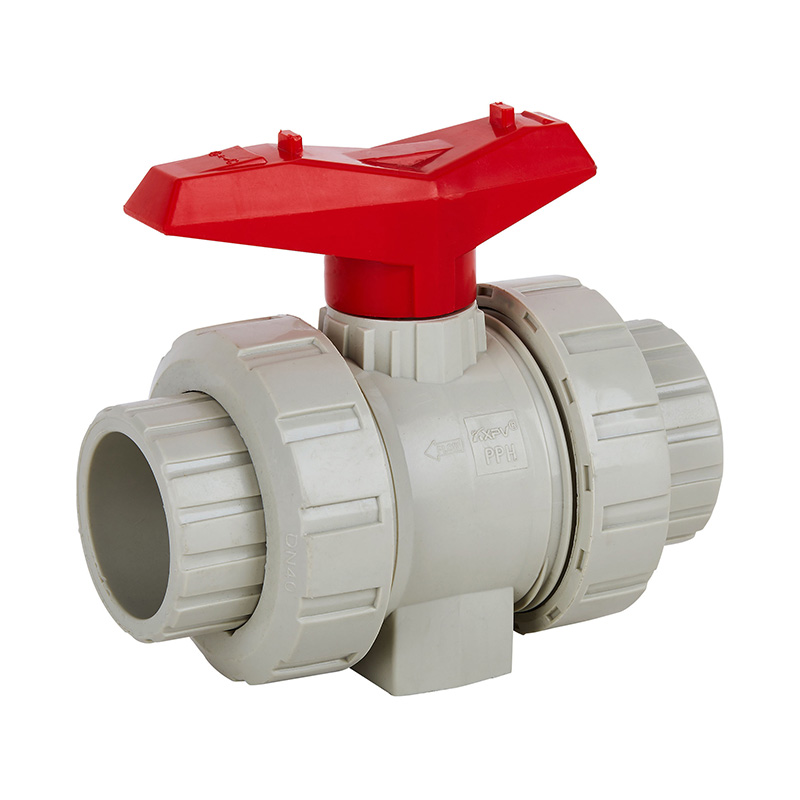
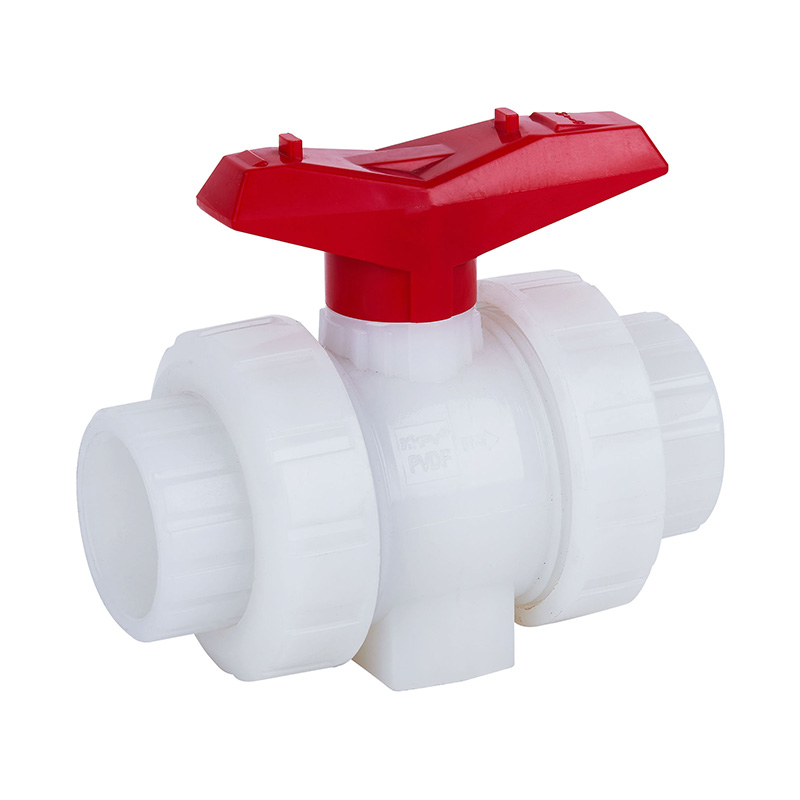
Step back when the chemistry is wrong. Hot concentrated sulfuric acid, fuming nitric acid, ketones, chlorinated solvents, and esters attack CPVC; softening or swelling leads to sudden failure, not a slow leak. For those services the usual thermoplastic answers are PVDF or PPH, or a lined metal valve.
Selection danger: do not specify CPVC in a solvent service simply because the pressure rating fits. Chemical incompatibility produces catastrophic failure, and no installation detail can save it.
What a Serious Supplier Should Show You
The valve is a simple machine; the discipline around it decides reliability. A serious manufacturer will produce five documents without hesitation:
- Material certificate for the CPVC compound used.
- Hydrostatic shell-test report for the production batch.
- Seat-leakage test results at the rated pressure.
- A pressure-temperature derating curve for the exact model.
- Dimensional inspection data for the end connections.
If the same supplier also manufactures pipe and fittings in the same material family, joint compatibility — socket dimensions, wall thickness, thermal behavior — is one less variable in your system. Kaixin Pipeline Technologies is one example: a manufacturer producing CPVC, UPVC, PVDF, PPH, and FRPP families since 1999, with its own polymer pipeline and valve R&D center, and ball-valve patterns that include one-piece, socket, and flanged double-union designs in the DN15–DN100 range.
The failures that recur in chemical plants are rarely caused by the valve material. They are caused by the half-specified order: the right body pattern with the wrong end connection, the right pressure rating at 20 °C with the wrong operating temperature, the right valve installed like a steel valve. Every one of those mistakes is preventable when the specification is checked against the actual service.
A CPVC union ball valve will not solve every corrosion problem. But in hot acid handling, electroplating, and wastewater service, it is a quiet, inexpensive, thoroughly proven answer. Specify the body pattern for access, verify the derating curve for temperature, support the piping, and the valve will remain the least interesting — and therefore the most reliable — component on the line.

 Headquarters: No. 539 Bohai Road, Beilun District, Ningbo City, Zhejiang Province, P.R. China
 +86-18067123177